Showing posts with label Rice. Show all posts

Wednesday, 23 May 2012

What a pilafer!

Dutifully, I checked the rations yesterday morning to see what particular delight I might concoct.  I had half a chorizo ring, half a red pepper and a courgette.  Pasta seemed like a viable option, but I'm a little bored of that at the moment.  I remembered I had about a litre of chicken stock in the freezer:  this, of course meant RISOTTO!

Everything was proceeding as I had foreseen it (cue evil cackle).  The chorizo was duly sliced and fried to release its orangey oil.  The vegetables were prepared.  The wine was open.  I reached into the cupboard to remove my plentiful supply of arborio only to recoil in horror at its complete and utter absence.  I was stuffed.

Now, Spanish wine can have a curious affect on the workings of a man's brain.  I decided to embark on a pioneering voyage to boldly go where no risotto had gone before.  For some unknown reason I decided to try making a risotto with basmati rice.  

In its essence, the only real difference I can detect between a pilaf and a risotto is the use of wine, and the particular grain of rice.  Arborio, being a very high-starch variety yields a type of pectin that effectively creams up your risotto.  I watched aghast, during last weeks "Saturday kitchen" when a well-known and respected English chef advocated the addition of cream to his risotto.  I only have three things to say to that - No, No and No.
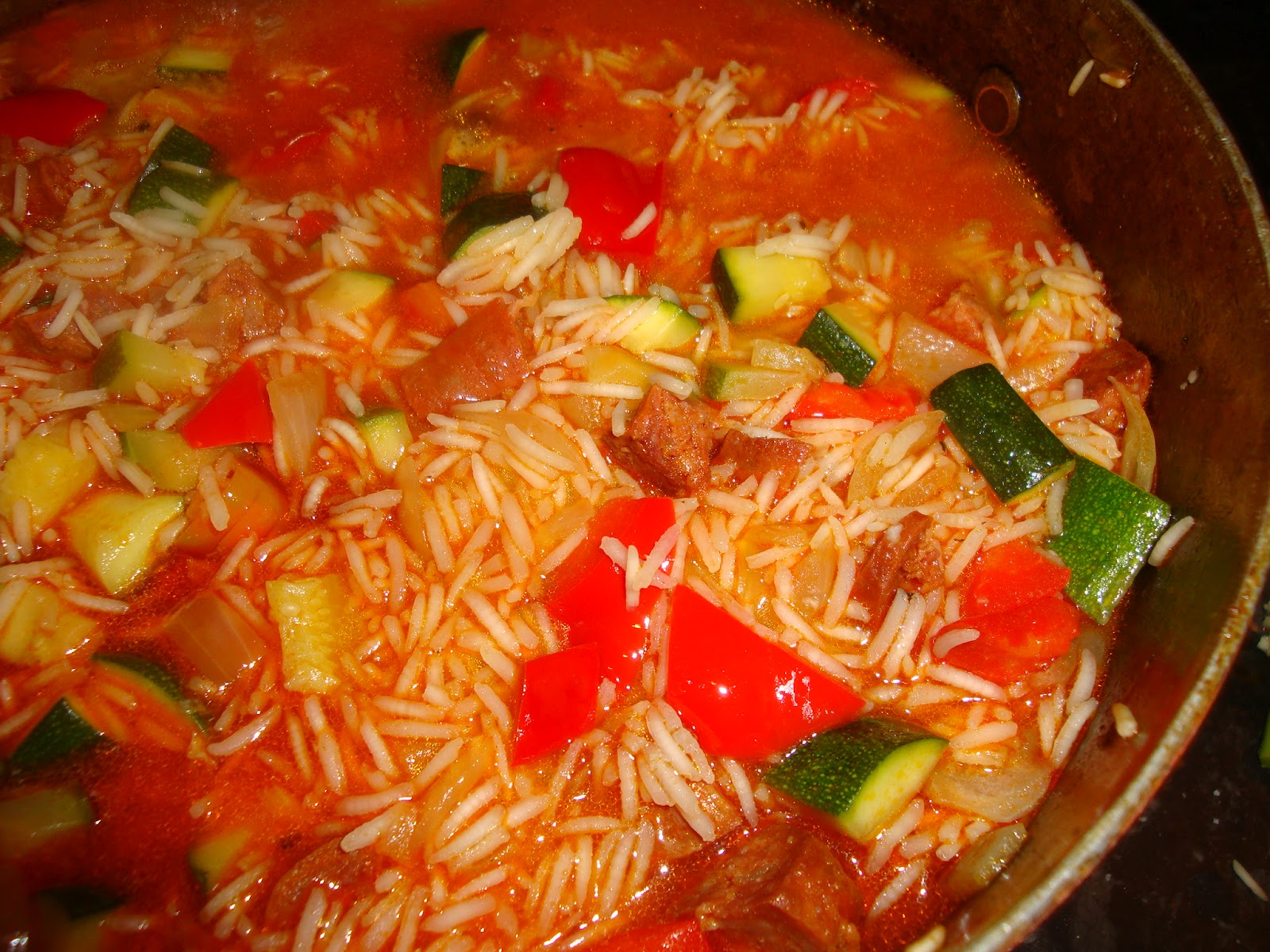
Chorizo, red pepper and courgette pilaf (risotto)
  •    Peel and cube the chorizo.  Fry in a little oil until slightly crispy.  Remove from the oil and drain on kitchen roll.
  •   Slice and dice, one onion, half a red pepper, one courgette and 3 cloves of garlic.  Add to a pan and sweat.
  •   When the vegetables have softened add your basmati (arborio) rice.  Stir to mix in the oil.
  •   Add a small glass of good white wine - I used an AlbariƱo.
  •   Season with lots of black pepper, but go easy on the salt as the chorizo is salty enough.
  •   Bring 500ml of chicken stock to the boil.  
  •   Add a ladle of stock.  Stir to mix.  
  •   When the rice has absorbed the stock add another ladle.
  •   Repeat until either the stock has gone or you feel the pilaf (risotto) is too wet.
  •   Add the chorizo.  Check seasoning.  Serve. 

Tuesday, 1 May 2012

Rice n' Beans.

There is something that is both financially and spiritually rewarding from using up leftovers.  The propensity to use what many people would just bin has become somewhat of an obsession.  We smile, smugly in our seats each night as we slurp the remnants of the previous day's ingredients.  

This weekend was spent celebrating the first birthday of our second son, Kasper.  All sorts of relatives came round to coo over our little scion amidst much devouring of food and guzzling of elixirs.  As a result of this little soiree we had around 300-400g of rather tasty roasted beef left over.  We had some, cold in sandwiches with English mustard on Sunday night and this was most flavoursome.  The remaining hunk I decided to finely dice and make a chile con carne out of (the recipe for which you will find on this post)

http://swlsk.blogspot.co.uk/2012/03/voodo-o-chile-chile-con-carne-alongside.html 

Chile con carne

As previously mentioned, the addition of beans to a chile is deemed incongruous by Mexicans, who seem to be rather exacting as to who this dish should be prepared.  This is a perfect example of a regional dish which over time and much Anglicization has become rather bastardized.  

We most frequently use kidney beans for our chile's in this house (and, I suspect, so do you too, if you make this), however I have become rather open-minded as far as which beans can be utilized.  Last night, for example, I used cannelini beans (which work rather well).  You can even pop a can of baked beans, wash off most of the viscous sauce, and use the remaining haricot beans.

I thought I'd give a quick precis as to how I cook and prepare my basmati rice.  It is very easy to get fluffy, individually-grained rice, cooked to perfection with the minimum of fuss.  Here's how I do it:


Fluffy Basmati Rice
  •   Take out however much rice you deem in requirement for your dish.  Put it into a saucepan.
  •   Wash the rice, at least once in cold running water.  The goal here is to remove some of the excess starch and rice powder.
  •   Fill the saucepan with enough water to cover it by 2cm.
  •   Bring to a slow simmer.
  •   After about 6 or 7 minutes, test it by eating a few grains.  If it seems "not quite but almost ready" drain it into a sieve.
  •   Stick the sieve back over the saucepan and settle a lid over the top.  Allow to steam.
  •   When you are ready to serve, fork the rice a little to separate the grains.  Be gentle. 

Wednesday, 28 March 2012

Risotto!

Rice seems to have managed to wiggle its way into just about every type of cuisine in the world.  Of course, everyone is familiar with its compatibility with Middle-eastern and Asian foods, from Indian to Indonesian, but its proliferation into paella, rice pudding, tex-mex and of course, risotto is not to be overlooked.  

I am lead to believe it is probably a combination of far eastern merchants and the Moorish incursions to Iberia that introduced the dissemination of this wonderful grain to Europe.  There are many types of rice varieties - the red camargue rice of France, bomba rice from Spain and basmati from India, Pakistan and Bangladesh.


I keep only two varieties of rice in my cupboard - basmati and arborio.  Arborio is used exclusively, (in my house) for making risotto.  There are some golden rules to making risotto, and as per usual I have a list to provide you with.  Transgress these at your peril:


  •   Risotto always starts with a sofritto - that is, onions, garlic, oil and butter.
  •   Never add any type of cheese to a risotto except for parmigiano regianno (I can probably excuse the use of grana padano or perhaps pecorino).
  •   The creamy consistency of a risotto is achieved by the slow stirring of the rice, releasing its starches.  It is never achieved by adding cream or ricotta.
  •   Ensure your stock is nice and hot when you begin adding it.
  •   Never overcook the rice.  It should have some bite left in it.
  •   The final consistency should be firm and not sloppy.

Tonight I am going to cook a bit of a melange, a fusion perhaps, of a risotto - and this is utterly guided by what I have left in my fridge.  I have a half ring of smoky chorizo, 2 small courgettes and some frozen peas left, mulling around not doing very much, just crying out to be used.  Here is how I will make my risotto:

Chorizo, courgette and pea risotto
  
  •  Chop the chorizo into small chunks.  Dry fry in a thick-based skillet and remove from the pan when the orange oil is released and they have become slightly crunchy.  
  •  Finely chop one medium onion, the courgettes (2 small ones, or 1 large) and 2 cloves of garlic.  Add a few good glugs of olive oil and a generous knob of butter.  Add the chopped ingredients.
  •   Fry on a medium heat until they absorb some of the oil and butter and become glistening.  Do not colour!
  •   Add the arborio rice, I usually just eyeball how much is needed.  Stir the grains to ensure that each is coated with some oil and butter.
  •   Heat your stock up - not boiling, but hot.
  •   Add a large glass of white wine - something dry, not fruity.  An orvieto, verdicchio or soave are fine.  Increase the heat and boil off the booze.  
  •   Add a handful of frozen peas.
  •   Add a ladle full of hot stock to the pan.  Stir slowly and not too vigorously.  
  •   When the stock has been incorporated into the risotto, add another and repeat this process until you have added all the stock.  For two people I would use 200g rice 500ml stock. 
  •   Check the rice, it should be soft on the outside and a bite in the centre.  The consistency should be creamy, thick, but not wet. This should be roughly 20-25 minutes.
  •   Add the chorizo to warm up.
  •   Turn the heat off.  Add 20g of finely grated parmigiano, a few good turns of ground black pepper.  Check for salt, it may not need it due to the salty chorizo and parmigiano. 
 Edit : Here's the risotto from last night!