Tuesday, 29 May 2012

Racking and bottling.

My "Nelsons Revenge" finally stopped bubbling yesterday afternoon after 5 dutiful days in the outside toilet.  The fermenter had an encouraging "mat" of yeast at the bottom and when I unplugged the airlock I got a wonderful whiff of fresh beer, carbon dioxide and depleted yeast.  It was ready for bottling!

Racking the beer out of a fermenter can be a long and arduous process.  Bottles needs to be rinsed, cleaned and then disinfected, as does the racking cane itself, the bottle tops and anything else than comes into contact with the hallowed liquid.  This took me an hour in itself.

Since the weather was so nice I set my little brewing factory out in the garden.  My 4 year old could not resist helping, so he got the job of spooning in half a teaspoon of caster sugar.  This is added to encourage a second fermentation in the bottle, which catalyzes a little extra fizz.

Beer Factory
It took us a further hour or so to fill and cap 40 bottles of amber nectar.  This is a monotonous procedure and rather akin to wrapping up Christmas presents - i.e it's boring, but you can't wait to get at what is inside.

My last batch of beer was very disappointing - it had little flavour or bitterness and to my rather expert opinion it was hugely lacking in the booze department.  I really hope these problems do not exhibit themselves in this particular brew as I think I am ready to down tools if it happens again.  You cannot imagine the despair of waiting 3 weeks to discover your beer has as much flavour as a 39p bottle of Tesco shandy.

A right bevvy of beauties

I now must wait for around 2 weeks for the beer to clear a bit, and for the secondary fermentation to halt.  That's good news though as I'm trying to stop drinking Monday - Thursday.  Too many summers of too much beer and too little exercise have conspired to expand my considerable girth.  It is time to sort out my gut.

Monday, 28 May 2012

Heatwave..

Any temperature more than +10C, or a period of weather where it does not rain for more than a week is automatically deemed a heatwave in England.  Should, in the extremely unlikely circumstance, the mercury bulb display the dizzy heights of more than 20C the tabloid newspapers feel it is necessary to scour the world section of some broadsheet to see exactly how much hotter London is, in comparison to say, Algiers.  The obligatory picture of overweight students in bikini's are emblazoned on every front page.

Well, that is just what has happened here in England since the end of last week.  We are experiencing some decent weather for a change.  In the last 3 days we have eaten fish and chips on the beach and had 2 barbecues - hence why there has been no update to my blog of recent.

I do hope you will excuse me, as I enjoy a cold beer in my garden and relax with the kids in the pool (a plastic paddling pool, which is infinitely impossible to inflate).

Friday, 25 May 2012

Pulled Pork.

I have quite a collection of culinary fails in my repertoire.  I attempted pulled pork about 9 months ago and failed dismally - I didn't cook the hand for long enough and the resultant pork was neither tender enough, nor "pullable".  I wanted to give this recipe another visit, and this time I did some serious research to make sure I got it right.


A 5kg hand of pork (or pork butt, as they call it in The U S of A) is the top of the front leg and shoulder.  It is a particularly resistant cut of meat and can withstand long durations in the oven without drying it out.  Indeed, it requires such long stretches inside to ensure you properly obliterate the collagen in the flesh.


I skinned my hand, by hand (messy, but fun) then made a marinade:


  •   One small onion, chopped and into the blender
  •   10 cloves of garlic, into the blender
  •   About 3 tablespoons of Worcestershire sauce into the blender
  •   About 3 tablespoons of dark soy sauce into the blender
  •   A squirt of tomato puree into the blender
Blend all this to a nice paste and then smear the hand with it and marinade over night


On the day (or, as in this case, morning) of cooking grease up a large baking tray and place the hand into it.  Preheat the oven to 120 Celsius and put the hand in.

I left my pork in the oven for 8.5 hours (bear in mind it was a 5kg, bone-in joint).  When I took it out it was rather black on the outside, so don't be alarmed.  The meat should be quite easily "pulled" off the bone and then you can shred it by using two forks, one in each hand:


I was surprised by the yield of pork I got.  Guess what we're eating for the next 3 days?

I then made a barbecue sauce to go with this.  Into a saucepan, place the following:

  •   a few decent lugs of Worcestershire sauce
  •   a few decent lugs of dark soy sauce
  •   a generous squirt of tomato ketchup
  •   about 4 tablespoons of cider vinegar
  •   a good pinch of smoked paprika
  •   a little dash of tabasco
  •   a teaspoon of dijon
  •   gently heat it up to combine all the ingredients

I served my pork the traditional way, in soft, white buns with coleslaw.  It was absolutely delicious and I cannot wait to make it again.  What's even better is that the whole 5kg hand cost me less than 4 quid!


Wednesday, 23 May 2012

On the brew...

Two blogs in one day I hear you cry?  Yes, indeed, a double-whammy.  The inspiration for this second dose was motivated by the necessity to inform you of a new arrival in our house!  That's right, we have a new baby.  Well, I do anyway.  It's called Nelson's Revenge and hopefully it will aspire to the dizzying heights of 5.0% ABV.

I broke out the brewing products, cleaned my barrels and pipes and prepared the outhouse for 6 days of sincere, unadulterated fermentation.

Actually, in truth, I wasn't expecting anything to happen.  This kit had been lingering in the store cupboard for about 18 months, but I can attest to the yeasts activity.  I took a little movie:


I now need to stay patient and try to keep my extremely curious kids from breaking into the outside toilet and drinking my homebrew.  The latter will be more difficult to maintain.

I shall keep you updated as to how this brewing voyage transpires over the next 2 to 3 weeks.
What a pilafer!

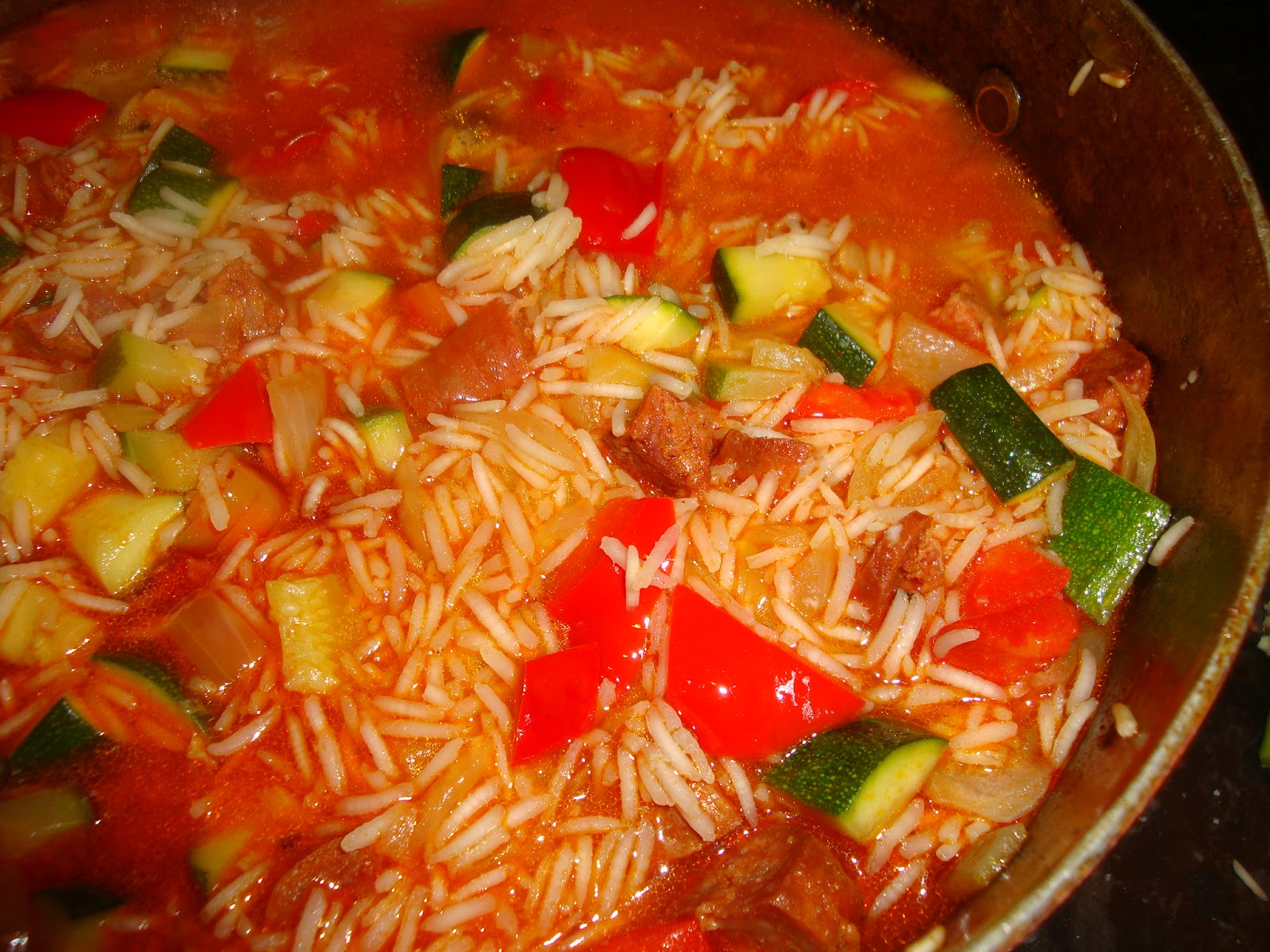
Dutifully, I checked the rations yesterday morning to see what particular delight I might concoct.  I had half a chorizo ring, half a red pepper and a courgette.  Pasta seemed like a viable option, but I'm a little bored of that at the moment.  I remembered I had about a litre of chicken stock in the freezer:  this, of course meant RISOTTO!

Everything was proceeding as I had foreseen it (cue evil cackle).  The chorizo was duly sliced and fried to release its orangey oil.  The vegetables were prepared.  The wine was open.  I reached into the cupboard to remove my plentiful supply of arborio only to recoil in horror at its complete and utter absence.  I was stuffed.

Now, Spanish wine can have a curious affect on the workings of a man's brain.  I decided to embark on a pioneering voyage to boldly go where no risotto had gone before.  For some unknown reason I decided to try making a risotto with basmati rice.  

In its essence, the only real difference I can detect between a pilaf and a risotto is the use of wine, and the particular grain of rice.  Arborio, being a very high-starch variety yields a type of pectin that effectively creams up your risotto.  I watched aghast, during last weeks "Saturday kitchen" when a well-known and respected English chef advocated the addition of cream to his risotto.  I only have three things to say to that - No, No and No.

Chorizo, red pepper and courgette pilaf (risotto)
  •    Peel and cube the chorizo.  Fry in a little oil until slightly crispy.  Remove from the oil and drain on kitchen roll.
  •   Slice and dice, one onion, half a red pepper, one courgette and 3 cloves of garlic.  Add to a pan and sweat.
  •   When the vegetables have softened add your basmati (arborio) rice.  Stir to mix in the oil.
  •   Add a small glass of good white wine - I used an AlbariƱo.
  •   Season with lots of black pepper, but go easy on the salt as the chorizo is salty enough.
  •   Bring 500ml of chicken stock to the boil.  
  •   Add a ladle of stock.  Stir to mix.  
  •   When the rice has absorbed the stock add another ladle.
  •   Repeat until either the stock has gone or you feel the pilaf (risotto) is too wet.
  •   Add the chorizo.  Check seasoning.  Serve. 

Monday, 21 May 2012

Cakes o' Fishness.

Bucking the usual trend of roast dinner on a Sunday we decided to use up some bits and bobs obstructing our larder.  A piece of salmon, defrosted yesterday and a can of mackerel looked decisively to me like fishcakes.  We really don't sit down together as often as we should for dinner, so we do try to do this of a Sunday.

The recipe for my way of making fishcakes can be found here http://swlsk.blogspot.co.uk/2012/03/fresh-from-capns-table.html 

We also had a fresh and crunchy pointed cabbage - a vegetable that is understandably ubiquitous at the moment left to eat, so this in turn, was made into my quick fire sauerkraut.  The recipe for this you can find here http://swlsk.blogspot.co.uk/2012/04/back-to-roots.html 

I made 6 fair-sized fishcakes, coated them in white breadcrumbs and set them on a board to refrigerate for 30 minutes or so.


I probably got the potato to fish ration messed up as I attempted to eke out a little fish between 3 people.  Actually you can probably count that as 3.5 people - my 4 year old son eats as much as a horse.

The fishcakes can be taken out the frying pan and placed into the often.  This helps to store them, but it also aids in browning the sides of the cakes too.

Mackerel and Salmon Fishcakes with Quick Sauerkraut and Peas


Sunday, 20 May 2012

The wonderful world of pasties.

Though indigenous to the southwest of England, Cornwall to be exact, pasties of all shape, size and filling can be found throughout our fair land.  Square ones, crescent ones, some filled with chicken tikka, some with steak and beans.  The traditional Cornish Pasty, proud owner of PGI (Protected Geographical Indication) is stringently controlled though.  Its shape and filling must meet exacting guidelines or it is simply not a Cornish Pasty.

The origins of the word pasty can be traced to the old English word for a pie baked without a dish and has been documented in historical writing all the way back to the 1300's.  Whether or not the English can lay claim to "discovering" the pasty is a matter for some thought.  I'm sure the Spanish empanada and the Indian Samosa would have something to say about that.

Fact of the matter is though, they are delicious.  I like them filled with anything, as long as it isn't tough old steak.  The brief instance of fear one experiences before biting into a cheese and bean melt (from Greggs, of course) as you try to anticipate the searing, volcanic filling exploding across your lips is a moment to savour - let alone the product itself.


A cheese and onion pasty, served with home made fried chips and baked beans is without doubt a triumvirate of triumph.  A hearty and over-zealous splodge of ketchup and this dish is complete.